A calm greeting is easier to teach when everyone knows what should happen before the door opens.
Jumping often persists because it works. A dog jumps, the person looks down, speaks, reaches toward the dog or pushes the dog away — and the dog receives interaction.
The solution is not simply saying “no” more often. Build a greeting routine in which staying on the floor reliably produces the things the dog wants.
First Understand Why Jumping Keeps Working
That distinction matters. A socially excited dog and a dog worried about approaching strangers may show superficially similar jumping but need different plans.
Choose the Greeting Before Training Begins
VCA recommends deciding what you would like the dog to do during greetings: remain standing with four paws on the floor, sit, lie down, stay neutral or wait for permission to approach.
For many households, four paws on the floor is the easiest foundation because the dog does not have to maintain a formal position every time another person appears.
Design the Entire Arrival Sequence
Training the whole sequence reduces the chance that the dog rehearses five seconds of chaos before anyone remembers to ask for a sit.
Management Is Part of Training, Not a Failure to Train
- close an interior gate;
- use an appropriate leash;
- create more distance from the doorway;
- place the dog in another comfortable area temporarily;
- ask visitors to wait before approaching.
- use a familiar helper;
- start with a calm approach;
- have rewards prepared before the person enters;
- reinforce before jumping occurs;
- end or reset if excitement becomes too high.
Teach Four Paws on the Floor Before Testing Real Visitors
“Sit to Greet” Is an Option, Not a Universal Requirement
VCA recommends first establishing the broader four-paws-on-the-floor behavior. If the household wants sitting to become the standard greeting, a sit can then be added and reinforced.
This distinction is useful for dogs that find sustained sitting uncomfortable or for situations where a calm standing greeting is perfectly acceptable.
Use a Helper to Control the Consequence
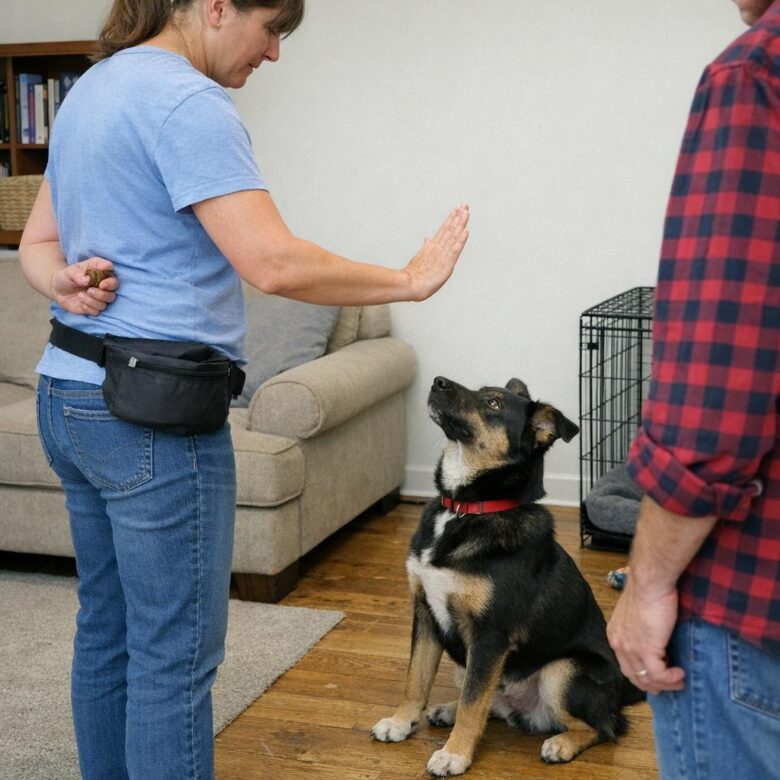
A training helper gives you something that random strangers cannot: predictable behavior.
| Dog does… | Helper does… | Handler does… |
|---|---|---|
| Approaches with paws down | Remains available for greeting | Marks and rewards |
| Sits if that is the trained behavior | Can gradually approach | Reinforces calm position |
| Begins jumping | Stops approaching or calmly withdraws | Reduces difficulty and waits for a trainable moment |
| Returns to paws-down behavior | Can become available again | Marks and reinforces |
| Becomes too excited to respond | Creates more distance | Ends or resets the repetition |
Dogs Trust recommends exactly this general progression: choose an alternative behavior, begin at enough distance for the dog to succeed, reward it, let the helper gradually interact and make the setup easier again if jumping returns.
What Should Happen When the Dog Jumps?
Shouting, pushing, grabbing paws or repeatedly talking to the dog can provide exactly the social interaction an attention-seeking dog wanted.
For an excited social jumper, the helper can remain calm, stop interacting or create distance, then allow another opportunity when the dog is back in a trainable state.
Do not use this as a blanket instruction for fearful or aggressive behavior. If the dog is jumping as part of anxiety, conflict or another serious behavior concern, the emotional problem needs to be considered separately.
Give Visitors a Script Before They Enter
Everyone in the Household Needs the Same Rule
If one person rewards four paws down but another person laughs, pets and hugs the dog every time it jumps, the dog receives conflicting information.
VCA specifically warns that intermittently rewarding jumping can strengthen the behavior. Dogs Trust likewise recommends having family and visitors follow the same greeting plan.
This does not mean every family member must train identically down to the smallest gesture. It means the main consequence should remain predictable: calm paws-down behavior makes greeting available; jumping does not become the fastest route to attention.
Petting Is Not Automatically a Reward
VCA emphasizes that some dogs enjoy touch during greetings and others do not. People should not reach toward a dog showing avoidance or fear merely because the dog has stopped jumping.
An Anxious Jumper Needs More Than Manners Training
Both VCA and Dogs Trust note that jumping can occur in dogs experiencing anxiety, uncertainty or conflict about an interaction.
Signs such as a tucked tail, avoidance, lowered posture, repeated panting unrelated to exercise, attempts to escape or other fearful body language change the interpretation of the greeting.
In that situation, do not force the dog to sit close to strangers so people can touch it. Increase distance, prevent unwanted contact and seek appropriate professional guidance if the problem is persistent or significant.
Safety Matters More Than Practicing a Greeting
VCA specifically notes that enthusiastic jumping can frighten people and may physically injure someone small or frail.
Track the Greeting, Not Just the Jump Count
Troubleshoot the Pattern Instead of Punishing the Dog
Use Reward-Based Training Rather Than Physical Corrections
The American Veterinary Society of Animal Behavior reaffirmed in 2025 that its current authoritative position remains its Humane Dog Training statement, recommending reward-based methods for dog training and behavior modification.
The organization specifically identifies common behaviors such as jumping as problems that can be managed by arranging the environment appropriately and reinforcing desirable responses.
Leash jerks, prong collars, electronic collars, hitting, kneeing the dog in the chest or other physical corrections are unnecessary for teaching a greeting alternative.
Know When the Problem Needs Professional Help
Professional assessment is appropriate when greetings involve aggression, intense fear, panic, severe frustration, inability to recover, repeated risk of knocking people down or a sudden meaningful behavior change.
A veterinarian can also help investigate whether pain, sensory decline or another medical problem may be contributing to an unexpected change in social behavior.
A Calm Greeting Is a Chain of Small Decisions
The final behavior may look simple: the visitor enters and the dog keeps all four paws on the floor.
But several pieces made that possible. The environment prevented an uncontrolled rehearsal. The person approached at a manageable level. The handler reinforced the desired response before the jump. The visitor followed the plan. And access to social interaction became part of the reward for calm behavior.
That is much easier for a dog to learn than alternating between being encouraged to jump, being pushed away and being told to sit after excitement is already too high.
Do not make “stop jumping” the entire lesson. Build a greeting routine the dog can actually succeed at.
Choose four paws on the floor, a sit or another appropriate alternative; manage arrivals before the dog rehearses uncontrolled jumping; reward the correct response early; let visitors know the rules; and increase greeting difficulty gradually. If the jumping appears connected to fear or anxiety rather than ordinary social excitement, give the dog more distance and address the emotional concern instead of forcing interaction.
Veterinary behavior and training references
This guide addresses common greeting-related jumping. Dogs showing aggression, significant fear or other serious behavioral concerns may need an individualized veterinary or behavior plan.
The Dogs Dance Editorial Team publishes practical guides about humane dog training, mental stimulation, enrichment activities, canine tricks, and responsible routines at home. Our content is created for general educational purposes and focuses on clear explanations, realistic expectations, and the everyday well-being of dogs and their families. It does not replace veterinary diagnosis, treatment, or individualized guidance from a qualified animal behavior professional.