Indoor exercise works best when the activity is designed around the space instead of trying to recreate an outdoor run inside the house.
A hallway, living room or small apartment can support useful movement, but tight turns, slippery floors, unstable furniture and repetitive jumping can also make an improvised game unnecessarily risky.
The goal is controlled movement that fits the individual dog’s age, mobility, fitness and health — not exhausting the dog at any cost.
First Decide What Indoor Activity Needs to Accomplish
Match the Activity to the Floor Plan
Small Homes Can Still Produce Useful Movement
A dog can move repeatedly between two safe positions, follow a handler around furniture, participate in controlled toy play or walk through a short course without needing a large indoor area.
The limitation of a small space is important, however: fewer straight-line meters often mean more turning. Avoid turning every indoor game into repeated high-speed pivots.
Six Indoor Activities That Can Be Adapted to the Space
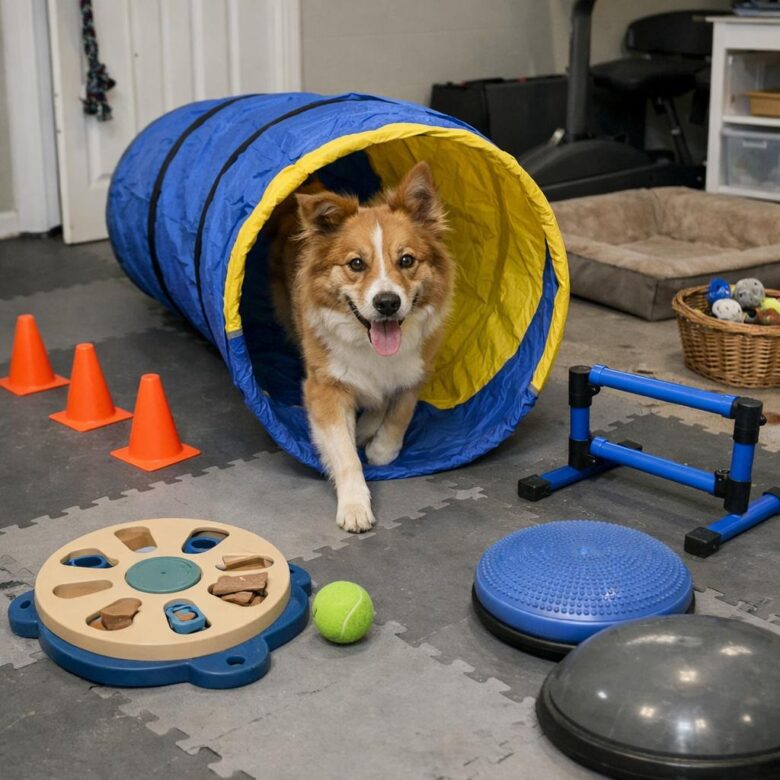
Build a Five-Station Indoor Movement Circuit
A circuit can make a small space more useful because the dog changes tasks instead of repeating one movement pattern continuously.
The circuit does not need a fixed number of laps. Stop while the dog is still moving comfortably and performing the activities with good coordination.
AAHA’s current indoor-enrichment guidance specifically recommends keeping improvised indoor obstacles low and stable, using nonslip surfaces, and adapting the activity to the dog’s age, size, mobility and fitness.
The Floor Matters More Indoors Than Many Owners Expect
- rubber-backed rugs or another secure nonslip surface;
- furniture that will not move if brushed;
- clear walking lanes;
- wide turns instead of abrupt pivots;
- low, stable course elements.
- slick hardwood or tile used for sprinting;
- unstable chairs or stacked cushions;
- high improvised jumps;
- areas containing sharp corners or breakable objects;
- tight routes that force repeated high-speed turns.
The AAHA Canine Life Stage Guidelines also recommend adding traction when mobility declines, particularly for senior dogs that struggle on slick flooring.
Do Not Use Stairs as a Default Indoor Workout
A dog that comfortably uses stairs in everyday life does not automatically need repeated up-and-down stair drills for conditioning.
Puppies, seniors and dogs with orthopedic, neurologic, visual or mobility limitations may require modified access to stairs. AAHA specifically recommends environmental adaptations for senior dogs and minimizing stair climbing when mobility makes it appropriate.
If a dog’s ability or willingness to use stairs changes noticeably, investigate the change rather than turning the stairs into a training challenge.
Choose Activities by Space and Dog, Not by Popularity
| Situation | Potential indoor choices | What to avoid |
|---|---|---|
| Small apartment | Target transfers, controlled tug, follow-the-leader, reward-based movement cues | High-speed fetch requiring abrupt stops against furniture |
| Long hallway | Calm recalls, controlled walking, gently rolled retrieval toy | Sprinting when the floor is slick or the stopping area is short |
| Open living room | Low obstacle route, wide weaving, interactive play | Unstable obstacles and high jumps |
| Several rooms | Hide-and-seek, room-to-room recalls, movement-and-search circuit | Routes through clutter or stairs when the dog has mobility limitations |
| Senior dog | Comfortable walking routes and veterinary-appropriate low-impact movement | Slippery floors, repetitive stairs and sudden high-intensity games |
| Puppy | Short, controlled exploration and age-appropriate reward-based games | Repetitive high jumps or using adult athletic routines as a target |
Track Intensity Without Chasing a Universal Time Target
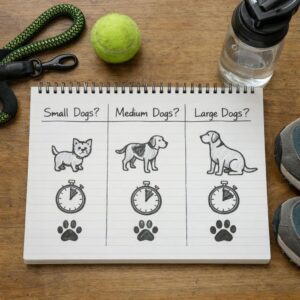
A fixed indoor duration is not appropriate for every dog. The physical demand of controlled walking is different from repeated tugging, jumping or sprinting even when both sessions last the same amount of time.
Alternate Movement With Lower-Intensity Work
This approach can be more practical than trying to make every minute indoors physically intense.
Mental Enrichment Is Useful — But It Is Not a Minute-for-Minute Exercise Replacement
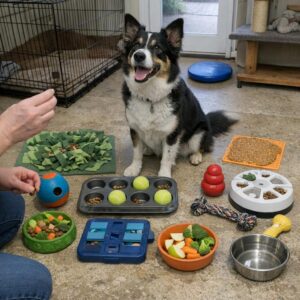
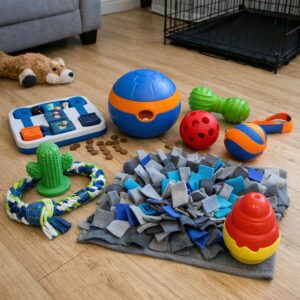
Searching, puzzles and training can provide valuable cognitive enrichment, and AAHA recommends them as part of a varied enrichment program.
That does not establish a universal formula in which a certain number of minutes of mental work equals a specific number of minutes of walking or physical activity.
If outdoor exercise is limited only temporarily because of weather, indoor movement and enrichment can help maintain routine until normal activities resume.
If the dog can no longer tolerate its usual outdoor activity because of pain, breathing difficulty, weakness or another health change, the solution is not simply increasing indoor activity. That change deserves veterinary assessment.
Reward the Movement You Want
Use food, toys, play or another appropriate reward to reinforce following, returning when called, moving to a target and navigating simple routes.
The American Veterinary Society of Animal Behavior continues to recommend reward-based methods for canine training and behavior work rather than aversive tools or physical punishment.
Avoid pulling a dog through obstacles, forcing body positions or using leash corrections to make the dog move faster through an indoor circuit.
Modify the Plan for the Individual Dog
Stop When the Dog’s Movement Changes
Create an Indoor Session From Four Decisions
A Useful Indoor Plan Does Not Need to Tire the Dog Out Completely
The phrase “burn off energy” can encourage owners to think success means leaving the dog exhausted.
A more useful goal is providing appropriate movement and enrichment while maintaining safe footing, normal coordination and comfortable recovery.
On a stormy afternoon that may mean several short activities distributed through the day. For another dog it may mean a modest indoor session combined with normal outdoor walks when conditions improve.
There is no requirement to transform a living room into a gym.
Indoor activity is most useful when it is designed around the dog and the space.
Clear the floor, create traction, choose controlled movements that fit the available room, keep obstacles low and stable, alternate higher-motion activities with searching or training, and watch how the dog moves and recovers. Indoor games can be an excellent backup when outdoor activity is limited, but they should add safe variety rather than encourage frantic exercise in a confined space.
Veterinary and behavior references
The activities in this guide are general enrichment ideas for dogs without specific exercise restrictions. Dogs with pain, mobility limitations, breathing problems or other medical conditions should have their activity plan discussed with a veterinarian.
- American Animal Hospital Association — Indoor Enrichment for Dogs
- American Animal Hospital Association — Enrichment at Home
- American Animal Hospital Association — Canine Lifestyle and Safety Assessment
- American Animal Hospital Association — Canine Life Stage Checklist
- American Animal Hospital Association — Cold Weather Pet Safety
- American Veterinary Society of Animal Behavior — Humane Dog Training Position Statement
The Dogs Dance Editorial Team publishes practical guides about humane dog training, mental stimulation, enrichment activities, canine tricks, and responsible routines at home. Our content is created for general educational purposes and focuses on clear explanations, realistic expectations, and the everyday well-being of dogs and their families. It does not replace veterinary diagnosis, treatment, or individualized guidance from a qualified animal behavior professional.