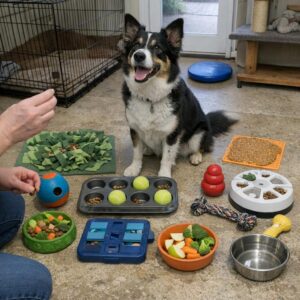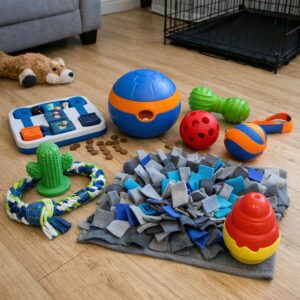
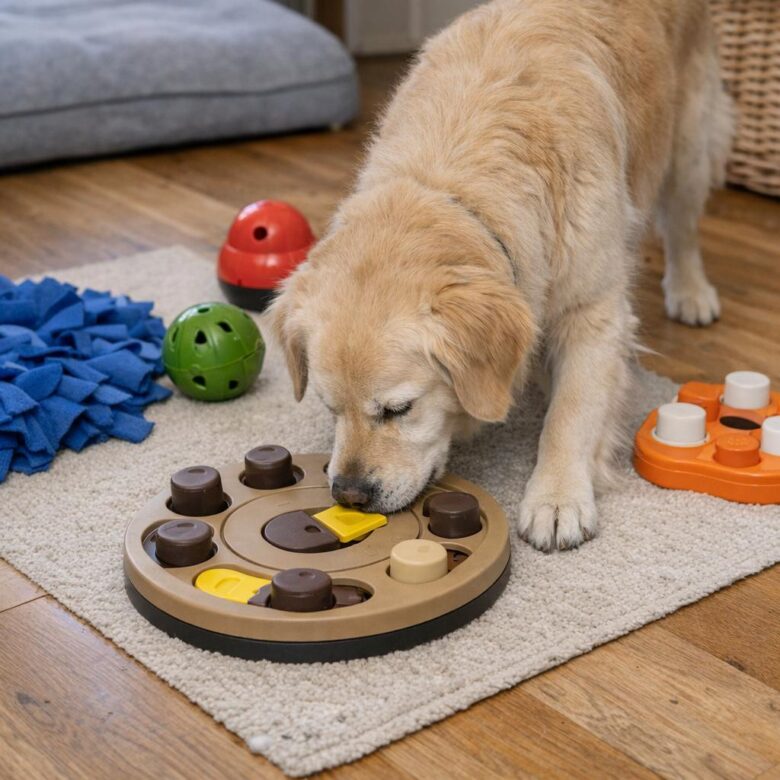
A useful brain game gives the dog a problem it can realistically solve.
The challenge might involve finding food by scent, investigating containers, manipulating an object, learning a small rule or searching for a familiar toy.
The goal is not to create the hardest puzzle possible. Good mental enrichment gives the dog enough information to begin, enough challenge to remain engaged and a safe way to stop whenever it chooses.
Brain Games Can Exercise Different Skills
“Mental stimulation” is a broad category. Two games can look completely different while both providing cognitive enrichment.
AAHA’s current enrichment guidance includes cognitive activities such as puzzle toys, positive training and hide-and-seek, while also emphasizing that dogs benefit from variety across physical, sensory, social and food-based enrichment.
Build Difficulty With Four Controls
Game 1: Build a Scavenger Search
AAHA’s updated indoor-enrichment guidance recommends scavenger hunts and specifically advises beginning with easy hiding locations before gradually increasing difficulty.
Think of the Room as a Search Grid
At the beginning, only one or two zones may be necessary. Expanding the search area is itself an increase in difficulty, even if the hiding places remain easy.
Game 2: Create a Towel Search
Game 3: Make a Supervised Search Box
Game 4: Use a Simple Container Search
Game 5: Hide a Familiar Toy
Game 6: Turn Training Into a Choice Puzzle
Watch the Dog to Calibrate Difficulty
- approaches voluntarily;
- continues investigating;
- can obtain success without becoming frantic;
- returns willingly when the activity is offered again;
- can disengage from the game normally.
- repeatedly abandons the problem;
- bites or claws at the setup frantically;
- barks continuously at the puzzle;
- begins destroying instead of solving;
- appears increasingly frustrated or worried.
A dog walking away is useful information. Mental enrichment is supposed to provide an opportunity, not an obligation.
Food-Based Brain Games Need a Calorie Budget
VCA recommends accounting for food used in training and foraging toys so the total daily intake remains appropriate.
For food-motivated dogs, part of a normal meal can often be reserved for search games or puzzles rather than automatically adding extra treats on top of meals.
Dogs with prescription diets, allergies, gastrointestinal disease, obesity or another nutrition-related condition should use foods consistent with veterinary guidance.
Not Every Brain Game Has to Contain Food
Some dogs enjoy searching for a familiar toy, finding a person during hide-and-seek, learning a target behavior or gaining access to a favorite game.
Reward-based training simply requires a consequence the dog values. What counts as valuable varies between dogs and situations.
Food can make many beginner games easier to design, but it does not need to become the only way a dog experiences mental enrichment.
DIY Brain Games Need a Safety Check
ASPCA’s current canine DIY-enrichment resource advises close, active supervision while homemade enrichment items are available and immediate removal if the dog attempts to ingest the material.
Use Separate Game Stations in Multi-Dog Homes
VCA warns that some animals may guard novel or food-filled toys and recommends using doors, gates, pens or other separation when necessary in multi-pet homes.
Do not create a competition in which two dogs are forced to solve the same food puzzle simultaneously if either dog is uncomfortable sharing.
If a dog shows aggression around food or high-value objects, seek appropriate professional guidance rather than repeatedly testing whether the guarding has “gone away.”
Adapt the Challenge to the Dog’s Life Stage
| Dog | Useful adjustment | What to watch |
|---|---|---|
| Puppy | Keep games easy, supervised and resistant to accidental ingestion. | Puppies often explore objects with their mouths, so materials need especially careful selection. |
| Healthy adult | Rotate search, problem-solving, training and exploration activities. | Do not increase difficulty merely because the dog is energetic. |
| Senior dog | Keep problems accessible and adapt placement to mobility, vision and hearing. | A puzzle that requires difficult movement may create a physical barrier rather than a useful cognitive challenge. |
| Mobility limitation | Bring the search area closer and reduce climbing, bending or unstable movement. | Follow veterinary exercise restrictions. |
| Dietary restriction | Use approved food or non-food reinforcement. | Do not let enrichment undermine the medical diet. |
VCA notes that puzzle solving and other enriching activities can be part of mental engagement for senior dogs, while physical demands should be adjusted to the individual dog’s abilities.
Do Not Diagnose Every Unwanted Behavior as Boredom
Chewing, barking, pacing, destruction or difficulty settling can occur when a dog lacks appropriate outlets, but those behaviors can also appear with anxiety, fear, pain, separation-related distress and other behavioral or medical problems.
A sudden or severe change should not simply be treated by adding a harder puzzle.
If unusual behavior appears abruptly, is intense, involves self-injury, occurs specifically during separation, or appears together with physical symptoms, veterinary or qualified behavioral assessment may be appropriate.
Brain Games Complement Exercise — They Do Not Convert Into Walking Minutes
AAHA and VCA both recognize cognitive enrichment as useful, but that does not establish a universal conversion such as “five minutes of mental work equals twenty minutes of exercise.”
A scent search may be mentally engaging while involving relatively little physical movement. A walk can provide physical activity while also allowing sensory exploration and sniffing. Both can belong in the same routine.
Dogs still need an exercise plan appropriate to their age, health, body structure and fitness. Brain games should add variety rather than become a justification for eliminating physical activity a healthy dog would otherwise receive.
Keep a Brain Game Passport
This type of record prevents enrichment from becoming an endless race toward harder puzzles. If the dog consistently enjoys an easy search game, there is no rule requiring it to become increasingly complicated.
Build a Small Library Instead of Using One Puzzle Every Day
The Best Brain Game Is One the Dog Can Participate In Safely
There is no universal puzzle that every dog should enjoy.
One dog may enthusiastically search boxes but show little interest in a commercial puzzle. Another may enjoy training far more than foraging. A senior dog may prefer a simple scent search that does not require difficult movement.
The dog’s response should guide the design.
If the game is too easy but still enjoyable, it can remain useful. If the dog understands it quickly, increase one challenge variable. If frustration rises, make the problem simpler. If the materials become unsafe, end the activity regardless of how mentally stimulating it appears.
A good brain game is not measured by how long it takes the dog to solve it.
Begin with an achievable search, manipulation or learning problem; observe how the dog approaches it; and change one element only after the activity is clearly understood. Use food within the dog’s feeding plan, supervise homemade materials, separate dogs when valuable resources could create conflict and adapt challenges for age, mobility and health. Mental enrichment is most useful when it creates safe opportunities to think and explore — not when it becomes another task the dog is forced to complete.
Veterinary and animal-welfare references
The activities in this guide are general enrichment ideas. Significant behavioral changes, resource guarding, dietary concerns or medical limitations may require individualized veterinary or behavior guidance.
- American Animal Hospital Association — Indoor Enrichment for Dogs
- American Animal Hospital Association — Mental and Emotional Enrichment at Home
- VCA Animal Hospitals — Environmental Enrichment With Food
- VCA Animal Hospitals — Enrichment and Foraging Toys
- VCA Animal Hospitals — Using Enrichment in a Dog’s Routine
- ASPCA — Canine DIY Enrichment and Supervision
- RSPCA — Reward-Based Training and Mental Activity
The Dogs Dance Editorial Team publishes practical guides about humane dog training, mental stimulation, enrichment activities, canine tricks, and responsible routines at home. Our content is created for general educational purposes and focuses on clear explanations, realistic expectations, and the everyday well-being of dogs and their families. It does not replace veterinary diagnosis, treatment, or individualized guidance from a qualified animal behavior professional.