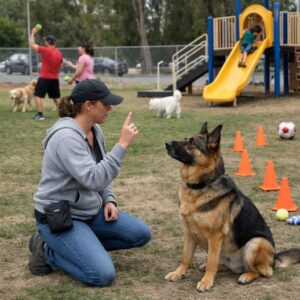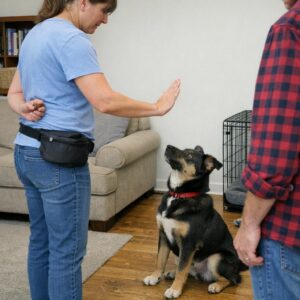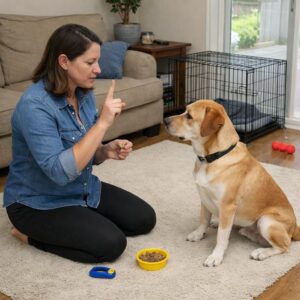
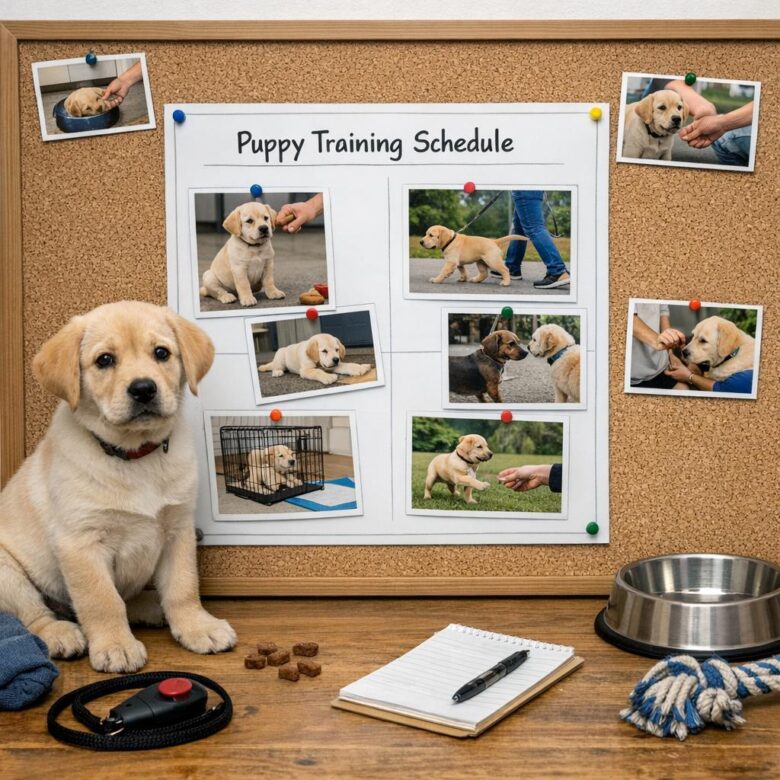
A puppy’s first year should not be managed like a checklist with a deadline beside every behavior.
Development differs with genetics, size, health, previous experience and environment. Some puppies arrive already comfortable with household sounds but know nothing about toileting. Another may be nearly house trained yet worried about unfamiliar people.
A useful first-year plan therefore tracks what the puppy needs next rather than asking whether every puppy of the same age has completed the same lesson.
Track Five Development Lanes Throughout the First Year
Early Socialization Is the Part of the Roadmap Where Timing Really Matters
The American Veterinary Society of Animal Behavior identifies the first three months of life as the primary socialization period and recommends safe exposure to a broad range of people, animals, environments and experiences without overwhelming the puppy.
AVSAB supports appropriately managed socialization before the puppy is fully vaccinated and states that organized puppy classes can, in general, begin as early as 7–8 weeks when specific health requirements are met.
However, infectious-disease risk varies by location. Your veterinarian should advise which environments are appropriate for your puppy’s vaccination status and local disease conditions.
High-traffic dog areas used by animals of unknown health or vaccination status are different from controlled socialization. AVSAB specifically advises avoiding unsanitized, heavily trafficked dog areas during this vulnerable period.
Use Development Phases as Planning Anchors, Not Deadlines
Start House Training on Day One
House training is one area where waiting for a particular age is unnecessary.
VCA recommends starting as soon as a puppy comes home. The core principles are supervision, predictable opportunities to eliminate in the correct location and positive reinforcement after success.
Confinement Training Should Build Comfort, Not Endurance Through Distress
A crate or puppy pen can be useful for transport, veterinary care, rest and household management, but simply locking a puppy inside does not teach comfort with confinement.
Teach Small Amounts of Independence Early
Independence training does not mean leaving a young puppy alone for an unrealistic workday.
It means practicing manageable separation while the puppy has appropriate physical and emotional support.
AVSAB recommends opportunities for puppies to play independently with appropriate toys and rest in safe confinement areas. AAHA’s 2026 preparation guidance also suggests brief, frequent departures as part of gradually building confidence with separation.
Teach Handling Before You Need to Clip a Nail or Examine an Ear
Handling should be practiced as a cooperative learning experience rather than introduced only when something unpleasant needs to happen.
| Body area | Beginner practice | Possible progression | Stop or simplify if… |
|---|---|---|---|
| Paws | Brief touch followed by reward | Hold gently, inspect toes, introduce grooming equipment separately | Puppy repeatedly pulls away or becomes worried |
| Ears | Touch outer ear briefly | Lift ear gently for a moment | Puppy avoids, freezes or appears painful |
| Mouth | Brief touch around muzzle | Gradually introduce lip lifting and oral-care handling | There is distress or possible oral pain |
| Body | Calm touch in comfortable areas | Practice brief examination-like handling | The dog becomes tense or attempts to escape |
AAHA’s puppy life-stage checklist specifically includes handling, desensitization for grooming and preparation for veterinary care. Its February 2026 veterinary-visit guidance recommends brief calm handling of paws, ears, mouth and body paired with positive reinforcement.
Puppy Mouthing Needs Management and Alternative Behaviors
Mouthing and nipping are common in puppy play. That does not mean the household has to allow hands, feet and clothing to become permanent toys.
- provide appropriate play and chew options;
- stop social play when biting becomes inappropriate;
- resume interaction when the puppy is calmer;
- keep household responses consistent;
- manage overtired or overaroused situations.
- hitting the puppy;
- holding the muzzle closed;
- roughly pushing the puppy away;
- encouraging hand biting sometimes and punishing it at other times;
- assuming all mouthing means aggression.
VCA veterinary behavior guidance explains that puppy nipping commonly occurs as social play, while Dogs Trust recommends withdrawing interaction, providing appropriate alternatives and avoiding punishment.
Do Not Forget Rest
Puppies may become increasingly mouthy, frantic or difficult to engage when they need rest. Training, play and exposure should therefore be balanced with opportunities to sleep undisturbed.
AAHA highlighted the relationship between sleep and puppy behavior again in July 2026, including the possibility that apparent evening “naughtiness” may be associated with insufficient rest rather than a need for more stimulation.
A first-year plan should not become a full-day curriculum of classes, walks, visitors, training and enrichment. Development requires downtime too.
Adolescence Is a Reason to Revisit Foundations, Not Declare Training Failed
As puppies mature, environmental interests, physical ability and social behavior can change. A response that looked reliable at home may become much harder around outdoor distractions.
Do not automatically interpret this as deliberate defiance.
Return to easier distances, improve reinforcement and prevent unsafe rehearsal while continuing reward-based training.
Do Not Use a Dog Park as a Socialization Requirement
AVSAB specifically advises avoiding dog parks and other heavily trafficked, unsanitized areas used by dogs of unknown vaccination or disease status during early puppyhood.
Even later, a dog park is only one type of environment. A puppy can learn valuable social skills by calmly observing other dogs, participating in controlled interactions and learning to disengage rather than being required to greet every dog.
Use a Skills Dashboard Instead of a Fixed Monthly Checklist
| Skill area | Foundation | Developing | Real-life goal |
|---|---|---|---|
| House training | Regular supervised toilet opportunities | Puppy begins signaling or following routine | Reliable habits appropriate to the household |
| Socialization | Safe, low-pressure exposure | Greater variety without overwhelming puppy | Dog can encounter normal life without needing to interact with everything |
| Handling | Brief comfortable touch | Longer or more specific handling | Routine care can happen with cooperation rather than force |
| Confinement | Voluntary entry and rest | Brief comfortable closure | Useful safe confinement for realistic situations |
| Independence | Rest while human remains nearby | Brief manageable separation | Comfort with appropriate periods apart |
| Recall | Return in easy environments | Gradually add distance and distraction | Strong safety behavior managed appropriately around real-world risk |
| Chewing | Provide appropriate options and supervision | Puppy increasingly chooses allowed items | Safe household habits with less management required |
| Settling | Reinforce short natural calm periods | Use comfortable resting areas in more situations | Dog can rest appropriately within normal household routines |
What If Your Puppy Is Already Older?
AVSAB emphasizes the importance of the first three months for socialization but also explicitly encourages owners of older puppies to continue introducing appropriate people, animals and locations.
An older puppy with limited experience may need a slower, more carefully controlled plan. Flooding the dog with dozens of new experiences in an attempt to “catch up” can increase fear rather than resolve it.
If an older puppy is already showing significant fear, avoidance or aggression, seek professional guidance rather than relying on a generic socialization checklist.
Know When the Roadmap Needs Professional Support
- household manners;
- recall foundations;
- handling exercises;
- appropriate socialization setups;
- coaching the household on consistency.
- sudden or marked behavior change;
- persistent fear or panic;
- aggression or significant safety concern;
- possible pain or illness;
- unexpected toileting changes after previous reliability.
Keep a Readiness Log Rather Than a Deadline Calendar
The First Year Is About Building Adaptable Skills
There is no prize for teaching every obedience cue before a puppy reaches a particular month of age.
A more useful goal is a young dog that has learned where to toilet, how to rest safely, how to interact with the household, how to experience new things without being forced, how to accept necessary handling and how to understand reward-based communication.
Those skills can later support formal obedience, sports, tricks or whatever activities suit the individual dog.
Use the first year as a roadmap, not a race.
Start household routines immediately, take advantage of the important early socialization period using safe and controlled exposure, build confinement through positive association, practice brief independence, prepare the puppy for handling and veterinary care, and continue reinforcing useful behavior through adolescence. Progress when the puppy is ready rather than because a calendar says the next milestone is due. The first birthday marks another stage of development — not the end of training.
Veterinary and behavior references
Vaccination schedules, infectious-disease risk, exercise restrictions and individual health concerns should be discussed with the puppy’s veterinarian. Behavioral training should use humane, reward-based methods.
- American Veterinary Society of Animal Behavior — Puppy Socialization and Humane Training Position Statements
- American Animal Hospital Association — What to Do When You First Bring Home a New Puppy
- American Animal Hospital Association — Preparing Before Bringing Home a Puppy
- American Animal Hospital Association — Canine Life Stage Checklist
- American Animal Hospital Association — Preparing for Veterinary Handling
- VCA Animal Hospitals — House Training for Puppies and Dogs
- VCA Animal Hospitals — Play Biting in Puppies
- Dogs Trust — Puppy House Training
- Dogs Trust — Puppy Mouthing, Nipping and Biting
The Dogs Dance Editorial Team publishes practical guides about humane dog training, mental stimulation, enrichment activities, canine tricks, and responsible routines at home. Our content is created for general educational purposes and focuses on clear explanations, realistic expectations, and the everyday well-being of dogs and their families. It does not replace veterinary diagnosis, treatment, or individualized guidance from a qualified animal behavior professional.