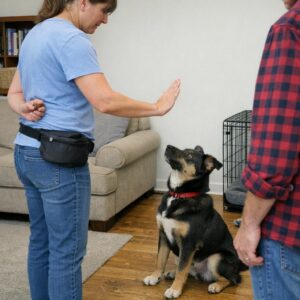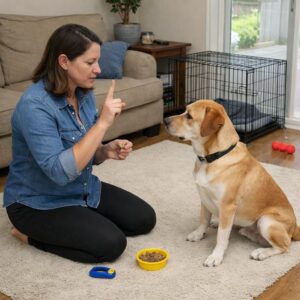
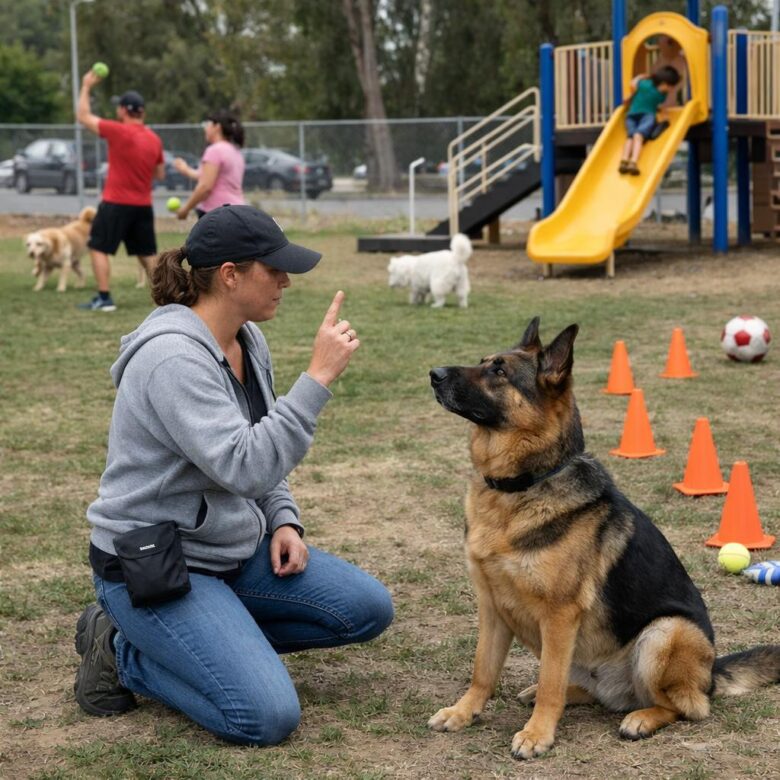
A dog responding perfectly in the kitchen does not prove that the same cue is ready for a crowded park.
New smells, moving dogs, squirrels, children, traffic, food on the ground and unfamiliar locations can all compete for attention.
Reliable responses are built by making those challenges gradually harder while continuing to make the correct response worthwhile and understandable.
Think of Difficulty as Three Separate Variables
This is why simply saying “practice around distractions” is incomplete advice. You need some control over how difficult the distraction actually is.
Identify the Dog’s Working Zone
The green-yellow-red model above is a practical training framework rather than a veterinary diagnostic scale. Its purpose is to help the handler recognize when difficulty should be reduced.
Establish a Baseline Before Adding Any Distraction
VCA recommends teaching cues in a quiet environment before gradually introducing distractions. Dogs Trust gives the same advice for attention, recall, stay and settle training.
Begin with a response the dog can perform easily enough that both dog and handler understand the training pattern.
Build Four Useful Responses Before Testing Hard Environments
You do not need all four to start distraction training. Choose the behavior that actually solves the situation you are working on.
For example, recall training and café settling are different problems. One requires leaving something interesting and moving toward the handler; the other requires learning to remain calm while activity happens nearby.
Create a Distraction Ladder
Write down several versions of one distraction before training around it.
Run a Controlled Distraction Trial
Match the Reward to the Difficulty
Dogs Trust recommends using particularly desirable rewards when asking a dog to respond around something highly interesting.
The useful reward may be food, a favorite toy, play, praise or access to something the dog wants, depending on the individual and the situation.
There is no universal hierarchy. A piece of kibble that works perfectly in the kitchen may be irrelevant beside a field full of interesting smells.
Do Not Turn One Cue Into Background Noise
Repeatedly giving a cue while the dog continues doing something else can make the cue less informative.
Dogs Trust specifically recommends using recall cues sparingly and avoiding repeated calling when the dog is unlikely to respond.
If the dog cannot respond, treat that as information about the setup: add distance, reduce distraction or physically manage the environment safely.
Different Distractions Need Different Training Setups
| Distraction | Easier starting version | Possible progression | Main mistake to avoid |
|---|---|---|---|
| Another person | Standing quietly at a distance | Walking, talking, then moving closer | Starting with direct greeting |
| Another dog | Calm dog visible far away | Reduce distance gradually while maintaining safe control | Using a crowded dog park as the first lesson |
| Toy | Low-value toy stationary on the floor | Higher-value toy, then movement | Beginning with the dog’s favorite moving toy |
| Food | Low-value food protected and inaccessible | Increase value or reduce distance gradually | Allowing repeated successful stealing |
| Jogger / bicycle | Stationary or slow-moving at substantial distance | Movement first, then gradually reduce distance | Waiting until the fast object passes directly beside the dog |
| New location | Quiet area with few events occurring | Return at somewhat busier times | Expecting home-level performance immediately |
A Cue Must Be Practiced in More Than One Context
Dogs Trust notes that a dog may initially behave as though a familiar cue applies only in the location where it was learned. When training moves somewhere new, returning temporarily to an easier version can help.
Reliable behavior therefore develops through successful practice across different environments — not by mastering the behavior once in the living room.
Do not treat that sequence as mandatory. A dog living in a high-rise apartment or a dog with behavioral challenges may need a different progression.
Recall Deserves Its Own Safety Rules
Fear and Reactivity Are Not Simply “Bad Listening”
If a dog is barking, lunging, trembling, trying to escape or showing other signs of significant fear or distress, repeatedly demanding “sit” or “watch me” may miss the underlying emotional problem.
Veterinary behavior guidance uses controlled techniques such as desensitization and counterconditioning for fear and anxiety. Exposure begins at an intensity low enough that the animal does not become overwhelmed, and distance is one of the main variables used to control that intensity.
For significant fear, aggression or reactivity, involve an appropriate veterinary or qualified behavior professional rather than treating the problem as a simple obedience failure.
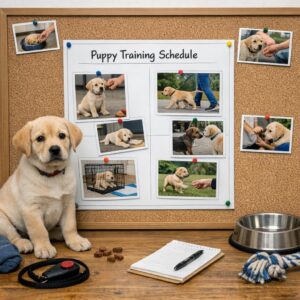
Keep a Distraction Training Log
A simple log can reveal progress that is difficult to notice from memory alone.
Debug the Training When Progress Stalls
Reward-Based Training Remains the Foundation
The American Veterinary Society of Animal Behavior continues to identify its 2021 Humane Dog Training Position Statement as its current authoritative position.
AVSAB recommends reward-based methods for dog training and behavior modification and advises against aversive methods including electronic collars, prong collars, choke chains, leash corrections and other physical or psychological punishment.
That is especially relevant around distractions. Punishing a dog for noticing something interesting or frightening does not teach the dog what response should happen instead.
Know When Professional Help Is the Better Next Step
Seek professional guidance when the dog shows persistent aggression, intense fear, panic, severe reactivity, sudden behavioral change, inability to recover after triggers, or behavior that creates a realistic safety risk.
A veterinarian can also help rule out pain, sensory changes or medical problems that may affect behavior. For significant behavioral concerns, veterinary behaviorists or other appropriately qualified reward-based professionals can help design a safer plan.
Reliability Is Built by Successful Repetition, Not by Testing Until Failure
A common mistake is continually making training harder until the dog finally fails. That proves only where the current limit is.
A better session creates many opportunities for the dog to make the desired choice successfully, then adds a small amount of difficulty.
If the dog struggles, stepping back is not losing progress. It is adjusting the lesson.
A reliable response around distractions is trained in layers.
Teach the cue clearly in an easy environment, identify a version of the distraction the dog can handle, control distance and intensity, reinforce successful responses and expand to new locations gradually. When the dog cannot respond, make the situation easier instead of repeating the cue more forcefully. And when fear, aggression or severe reactivity is involved, treat the emotional problem as more than simple “listening.”
Training and veterinary behavior references
The guidance in this article focuses on ordinary training distractions. Dogs showing significant fear, aggression or reactivity may need an individualized behavioral and veterinary assessment.
- American Veterinary Society of Animal Behavior — Humane Dog Training Position Statement
- VCA Animal Hospitals — Using Predictable Rewards to Train Your Dog
- VCA Animal Hospitals — Desensitization and Counterconditioning
- Dogs Trust — Focus and Attention Training
- Dogs Trust — Recall Training
- Dogs Trust — Training Stay Around Distractions
- Dogs Trust — Settle Training
- RSPCA — Reward-Based Dog Training
The Dogs Dance Editorial Team publishes practical guides about humane dog training, mental stimulation, enrichment activities, canine tricks, and responsible routines at home. Our content is created for general educational purposes and focuses on clear explanations, realistic expectations, and the everyday well-being of dogs and their families. It does not replace veterinary diagnosis, treatment, or individualized guidance from a qualified animal behavior professional.