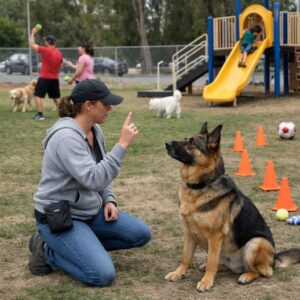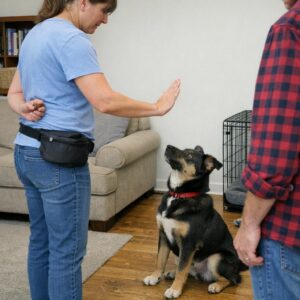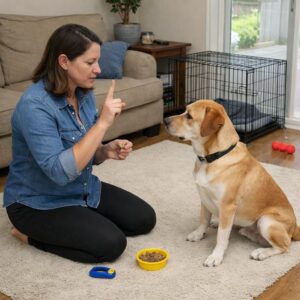
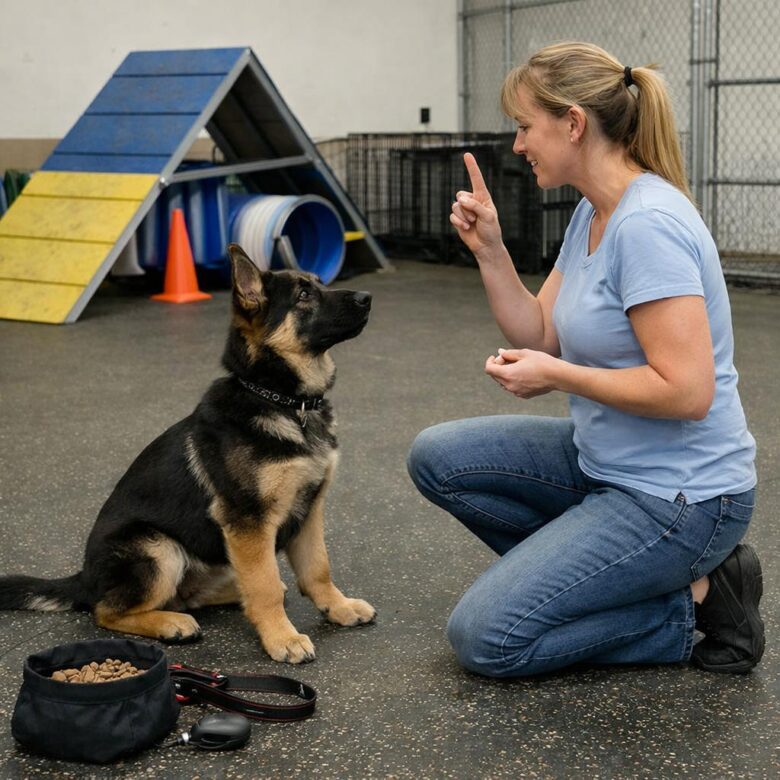
The first skills a dog learns should solve real problems in that dog’s life.
A perfect sit is useful in many situations, but it does not bring a dog back from a distance, prevent the dog from picking up unsafe trash or help the dog release something already in its mouth.
For that reason, beginners can get more value from prioritizing cues by function: attention, movement, object safety, boundaries and settling.
Choose Priorities Using Three Questions
Six Cues Cover Many Everyday Situations
Cue 1: Teach the Dog’s Name as an Attention Signal
Dogs Trust specifically recommends teaching a clear name response before adding recall and advises starting in a quiet environment before generalizing to more distracting locations.
Cue 2: Build a Recall That Is Worth Responding To
Do not punish the dog after it returns. VCA advises keeping recall rewarding, while Dogs Trust recommends progressively adding distance and distractions and maintaining valuable reinforcement.
Cue 3: Teach “Leave It” Before the Dog Has the Item
Current guidance from both the RSPCA and Dogs Trust uses essentially this progression: protect the item, reinforce backing or looking away, then add the cue once the behavior is predictable.
Cue 4: Teach “Drop It” Through Trading, Not Chasing
If a dog freezes, growls, snaps or shows other guarding behavior around possessions, do not repeatedly test the dog or reach forcibly into its mouth. Resource guarding can require an individualized professional plan.
Cue 5: Build Doorway Control With “Wait” and a Release Signal
Dogs Trust points out that a dog does not even need to sit at every doorway. The functional goal is patient, controlled boundary behavior. Access to the outdoors can itself reinforce waiting.
The exact word is not important. Consistency is.
Cue 6: Teach “Go to Place” as a Household Management Skill
VCA describes “go to place” as a practical skill for having a dog remain in a designated area during situations such as guest arrivals, while Dogs Trust recommends building settling behavior first in easy environments and later adding distractions.
Where Are Sit, Down and Stay?
Sit can simplify greetings or handling. Down can support relaxation or positioning. Stay can build duration and distance.
But a dog that can perform a beautiful sit and cannot disengage from dangerous trash still has a major gap in practical training.
Teach sit, down and stay when they solve a useful problem for your household. The RSPCA’s current stay guidance recommends building duration first, then distance, then practicing across different environments rather than demanding a long stay immediately.
Choose Your Starting Cue From the Situation
| Situation | Useful priority | Why | Management while training develops |
|---|---|---|---|
| Dog becomes distracted before another cue | Name response | Creates an attention step before further communication. | Increase distance from difficult distractions. |
| Dog needs to return from a distance | Recall | Brings the dog back toward the handler. | Use leash, long line or secure fenced area as appropriate. |
| Dog approaches trash or unsafe food | Leave it | Interrupts pickup before the object enters the mouth. | Prevent access and scan the environment. |
| Dog already has an object | Drop it | Creates a voluntary release behavior. | Avoid chasing or forcibly grabbing unless an immediate emergency requires action. |
| Dog rushes through doors | Wait + release | Builds predictable boundary behavior. | Use leash, gates or closed secondary doors when necessary. |
| Dog crowds visitors or cooking area | Go to place | Provides a specific alternative location. | Use barriers when the station behavior is not yet reliable. |
Make Every Cue Pass Four Reliability Levels
A cue should not be considered “proofed” merely because the dog performed it ten times in the kitchen.
An Emergency Stop Can Be a Valuable Advanced Skill
However, an emergency stop should not replace a leash near traffic or another predictable hazard. It is an additional trained behavior, not an invisible safety barrier.
Train All of These Skills With Rewards
The American Veterinary Society of Animal Behavior reaffirmed that its current position recommends reward-based methods for all canine training and behavior modification.
Electronic collars, prong collars, choke chains, leash corrections and other physical or psychological punishments are not necessary for teaching recall, leave-it, drop-it, boundaries or stationing.
Reward-based training does not mean allowing the dog unlimited access to dangerous situations. Humane management — leashes, barriers, gates, secure storage and appropriate distance — can prevent problems while training develops.
Keep a Cue Priority Scorecard
The Most Useful Cue Is the One That Solves the Situation You Actually Have
You do not need to race through a traditional obedience checklist before teaching skills that matter to your dog’s daily life.
Build attention so communication can begin. Teach recall for returning toward you. Use leave-it before an object is taken and drop-it for releasing something already held. Create controlled doorway behavior and a clear release. Teach a station that gives the dog somewhere appropriate to go when household activity becomes complicated.
Then add sit, down, stay, loose-leash walking, tricks and other behaviors according to your priorities.
Prioritize function before tradition.
A practical training foundation is not defined by how many commands a dog can demonstrate in the living room. It is defined by whether the dog and handler have clear ways to communicate during real situations. Teach the cues your household needs most, begin where success is realistic, reinforce generously while the behavior is developing, expand difficulty gradually and keep physical management in place whenever a failed response could create danger.
Training and veterinary behavior references
The skills in this article are general training tools. Recall and other cues should not replace physical safety measures around traffic, wildlife or other predictable hazards. Resource guarding, significant aggression or severe fear may require individualized professional guidance.
- American Veterinary Society of Animal Behavior — Humane Dog Training Position Statement
- VCA Animal Hospitals — Training Cues and Reward-Based Learning
- VCA Animal Hospitals — Recall and Wait Training
- VCA Animal Hospitals — Teaching Drop It
- VCA Animal Hospitals — Recall, Stop, Leave It and Drop It for Off-Leash Safety
- VCA Animal Hospitals — Teaching Go to Place
- Dogs Trust — Name Response Training
- Dogs Trust — Recall Training
- Dogs Trust — Leave It and Trading
- Dogs Trust — Doorway Training
- RSPCA — Teaching Leave It
- RSPCA — Building Stay Gradually
The Dogs Dance Editorial Team publishes practical guides about humane dog training, mental stimulation, enrichment activities, canine tricks, and responsible routines at home. Our content is created for general educational purposes and focuses on clear explanations, realistic expectations, and the everyday well-being of dogs and their families. It does not replace veterinary diagnosis, treatment, or individualized guidance from a qualified animal behavior professional.