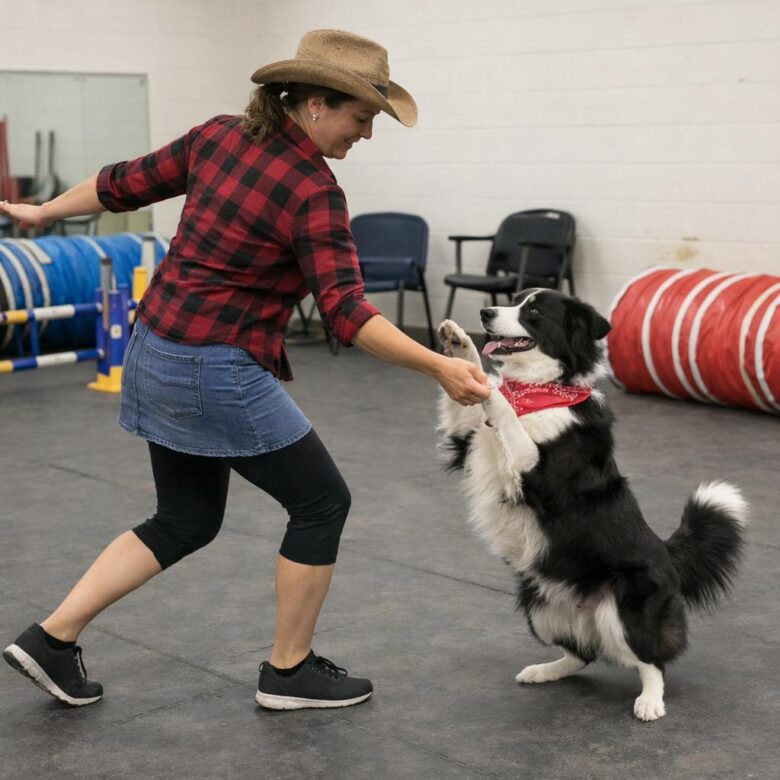
Canine freestyle is not about making a dog imitate a human dancer.
It is a cooperative activity in which trained behaviors, handler movement and music are arranged into a routine that suits the individual dog.
A beginner does not need spectacular jumps, dozens of tricks or professional dance experience. A short sequence built from three reliable behaviors can teach the core skill of freestyle: moving smoothly from one behavior to another while keeping the dog comfortable and engaged.
Musical Freestyle and Heelwork-to-Music Are Not Exactly the Same
- close-position movement is emphasized;
- multiple heel orientations are possible;
- distance work is not part of WCFO HTM;
- weaving and intentional jumping are also excluded from that WCFO style.
- tricks can be incorporated;
- distance between dog and handler can vary;
- movement can happen from many orientations;
- routine design has considerable creative freedom.
Start With a Movement Vocabulary, Not a Song
A common beginner mistake is choosing music first and then trying to force the dog to learn enough behaviors to fill it.
Reverse the process. Start by listing behaviors the dog already performs comfortably and reliably.
The movement does not need to look impressive on its own. A simple behavior becomes useful in freestyle when it connects naturally to another behavior.
Create a Routine Inventory
If only three boxes are reliable, that is enough to begin.
Build the Routine Before Adding Music
Your First Routine Can Be Four Frames
This might last only a few seconds during early training. That is fine. The purpose is to learn sequencing, not to immediately create a competition-length performance.
Transitions Are the Hidden Skill in Dog Dancing
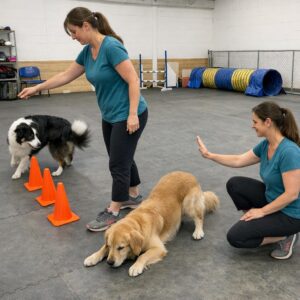
Suppose the dog finishes a behavior several feet away but the next move requires close heel position. The routine needs a trained way to bring the dog back rather than leaving the handler improvising in the middle of the sequence.
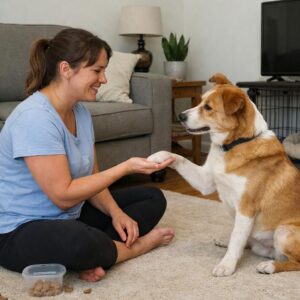
Hand targeting, short positioning behaviors and familiar walking patterns can act as connectors between larger movements.
Transitions also protect training quality. They give the dog predictable information instead of asking it to guess which trick is coming next.
Choose Music That Fits the Team
- choose music you can hear clearly and move to comfortably;
- watch the dog’s natural movement speed before choosing tempo;
- look for obvious musical phrases that make transitions easier;
- start with a short excerpt while practicing;
- avoid designing the routine around dramatic physical moves the dog cannot comfortably perform.
The Canine Freestyle Federation describes musical choice as part of presenting the dog’s movement to its best advantage, rather than making the dog conform to choreography that does not suit it.
You Do Not Need to Count Music Like a Professional Dancer
A simple structure is enough for a beginner. Listen for repeating groups in the music and place one routine event in each section.
This is a choreography aid, not a competition scoring system. The point is to give the handler predictable places to cue behaviors.
Train the Pieces Before Training the Performance
If the routine repeatedly falls apart in one place, return to transition practice rather than running the complete routine over and over.
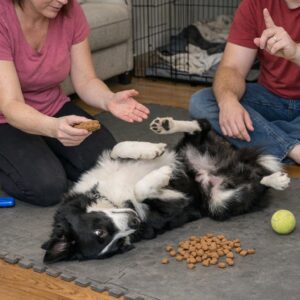
Use Rewards While Teaching
The American Veterinary Society of Animal Behavior continues to recommend reward-based methods for dog training. Rewards can include food, toys, play or another consequence the individual dog genuinely values.
During training, reinforce new movements and difficult transitions generously. Once a behavior is well learned, reinforcement can be arranged differently while maintaining motivation and clarity.
Current WCFO competition rules prohibit food, bait and training aids inside a judged routine. That does not mean beginners should train without rewards. It means competition behavior is prepared through training before entering the ring.
The Dog Does Not Need to Be Physically Spectacular
Musical freestyle often appears online as routines containing jumping, weaving, standing behaviors and rapid direction changes. Those movements are optional.
A routine can be designed around the individual dog’s strengths. WCFO even maintains competition divisions for senior dogs and for dogs or handlers with physical challenges, illustrating that freestyle can be adapted rather than requiring one athletic template.
Debug the Routine Instead of Blaming the Dog
Competition Can Come Later
For readers interested in formal events, current WCFO rules include Beginner Musical Freestyle and Heelwork-to-Music divisions. Beginner WCFO routines currently run from 1 minute 30 seconds to 2 minutes 15 seconds, with eligible beginner entries available on or off leash depending on category.
Those times are competition requirements for that organization — they are not a recommended duration for a first home-training routine.
At home, a beginner can start with a sequence lasting only a few seconds and gradually add material after the movements become reliable.
Use This First-Routine Checklist
| Before adding music | Ready? | What to change if not |
|---|---|---|
| Dog knows at least three comfortable behaviors | □ | Train individual skills before choreography. |
| Each behavior works in the practice room | □ | Reduce distractions and reinforce success. |
| Behavior 1 connects smoothly to Behavior 2 | □ | Practice only that transition. |
| Handler can remember the sequence | □ | Remove a step or create a clearer storyboard. |
| Surface provides safe traction | □ | Move to an appropriate practice area. |
| Dog remains comfortable and engaged | □ | Shorten the session, improve reinforcement or change the movement. |
| Music fits the team’s movement speed | □ | Try a different excerpt rather than forcing faster movement. |
Build Around What Your Dog Does Well
There is no requirement that a beginner routine contain a dramatic move.
A dog that enjoys close movement may build a routine around position changes. A dog that enjoys targeting can use targets to create direction changes. Another may have one expressive trick that becomes the feature moment of the performance.
The choreography should make the dog’s existing abilities look intentional rather than use music as an excuse to demand movements the dog is not ready to perform.
Your first canine freestyle routine does not need to look like a competition performance.
Choose a few behaviors your dog already performs comfortably, connect them with simple transitions, select music that fits the team’s natural movement and practice the pieces with reward-based training. Once the sequence feels easy for both partners, extend it gradually. In freestyle, complexity can come later; clarity, comfort and cooperation belong in the routine from the beginning.
Training and canine freestyle references
Competition rules can change and differ between organizations. Check the current rules of the organization hosting an event before preparing a competitive routine.
- World Canine Freestyle Organization — Musical Freestyle
- World Canine Freestyle Organization — Heelwork-to-Music
- World Canine Freestyle Organization — Current Competition Rules
- World Canine Freestyle Organization — Freestyle Proficiency Tests
- American Veterinary Society of Animal Behavior — Humane Dog Training Position Statement
- American Animal Hospital Association — Safe Indoor Dog Activities
- Canine Freestyle Federation — Canine Freestyle as a Performance Discipline

The Dogs Dance Editorial Team publishes practical guides about humane dog training, mental stimulation, enrichment activities, canine tricks, and responsible routines at home. Our content is created for general educational purposes and focuses on clear explanations, realistic expectations, and the everyday well-being of dogs and their families. It does not replace veterinary diagnosis, treatment, or individualized guidance from a qualified animal behavior professional.