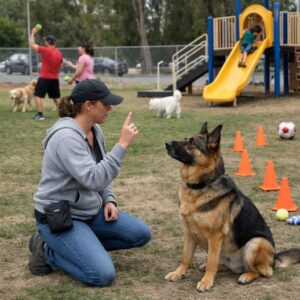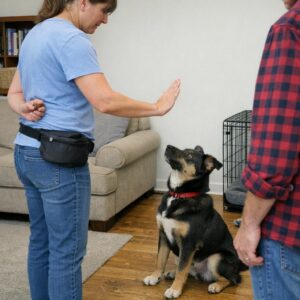
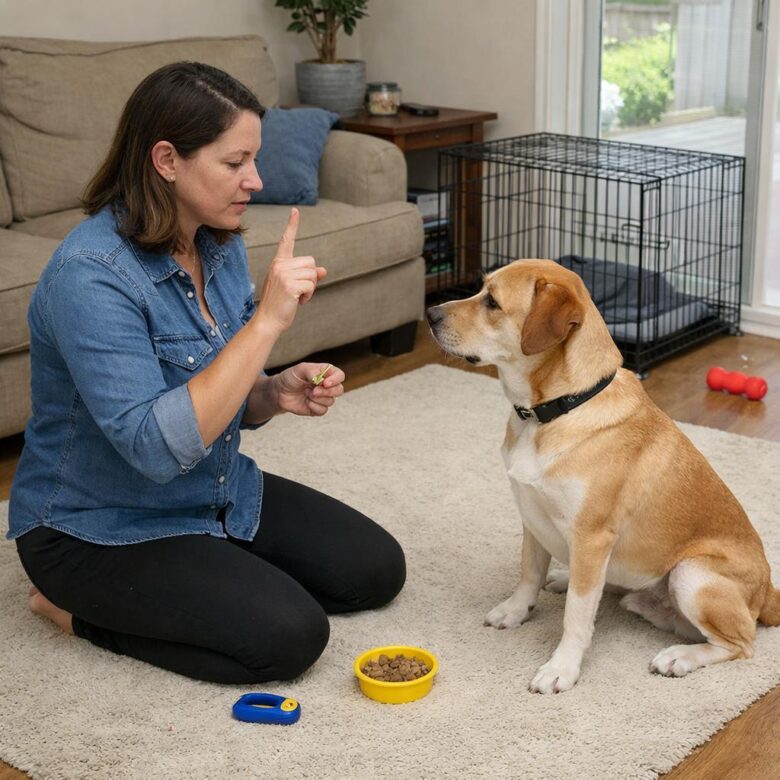
Training at home becomes much easier when you stop trying to teach “good behavior” and start teaching specific actions.
A dog cannot perform “be good.” A dog can walk toward a mat, keep four paws on the floor, return to a person, wait while a door opens or move away from an object.
The first skill for a beginner trainer is therefore not giving commands. It is defining exactly what behavior you want the dog to learn.
Turn a Vague Goal Into Something You Can Reinforce
The same principle works for many household concerns. Instead of “stop being wild at the door,” choose a specific alternative such as waiting behind a boundary. Instead of “listen to me outside,” define the exact response you need in that situation.
Create a Behavior Brief Before You Start
Use the Same Seven-Step System for New Behaviors
Step 1: Make the First Lesson Easier Than Real Life
The front door may be where you eventually need a behavior, but it may be the worst place to teach it for the first time.
VCA’s current training guidance recommends beginning in an easy environment with few distractions and later practicing the learned skill in additional rooms, the yard and progressively more challenging locations.
- familiar room;
- few people moving around;
- no competing toys on the floor;
- reward prepared before training;
- enough space for the movement being taught.
- visitors arriving;
- another dog playing nearby;
- busy sidewalks;
- meal preparation with food everywhere;
- situations where failure creates a safety risk.
Step 2: Introduce a Clear Marker
VCA describes a marker as a brief, distinctive sound or gesture predicting that something the dog values will follow. Examples can include a clicker, a short word or an appropriate visual signal.
The marker is different from general praise. Its job is precision: it tells the dog, “that particular action was the one.”
You do not need a clicker to train successfully. A consistent short word can work well when used clearly and followed by reinforcement.
Step 3: Choose How You Will Produce the Behavior
| Method | What it means | Useful example | Main consideration |
|---|---|---|---|
| Luring | Temporarily guide movement with food or another appropriate lure. | Guide the dog toward a simple position. | Fade the visible lure so food does not become a permanent part of the cue. |
| Capturing | Reinforce a behavior the dog naturally offers. | Mark a naturally offered relaxed position. | You need to notice the behavior when it happens. |
| Shaping | Reinforce successive steps toward a final behavior. | Look at mat → step toward mat → move onto mat. | Criteria need to increase in achievable increments. |
| Targeting | Teach the dog to move a body part toward a defined target. | Nose to hand or move toward a station. | Useful for guiding movement without physically pushing the dog. |
There is no requirement to use the same method for every behavior. Choose the approach that creates the clearest and most comfortable learning path for that dog.
Step 4: Add the Cue After the Behavior Makes Sense
Current VCA guidance recommends introducing a cue when you are confident the dog understands the action and is about to perform it.
This prevents a common beginner problem: repeating a word while the dog is still guessing what the word means.
A cue may be verbal, visual or environmental. For example, a hand gesture can signal a trained movement, while the appearance of a mat can eventually become part of the context for going to that location.
Step 5: Run a Simple Training Loop
A training session does not need dozens of repetitions. VCA recommends beginning with very short skill sessions, especially for puppies, while Dogs Trust similarly emphasizes simple, manageable sessions.
Step 6: Use Rewards the Dog Actually Values
Dogs Trust notes that reward value changes with context. Something that is valuable in a quiet room may become much less interesting outdoors around competing sights and smells.
Do not assume praise, petting or a particular treat is universally reinforcing. Watch what makes the individual dog more likely to participate and repeat the behavior.
Step 7: Generalize the Skill Instead of Assuming the Dog “Knows It Everywhere”
VCA’s updated 2026 cue-training guidance specifically recommends moving farther away when a distraction becomes too difficult and returning to foundational training when responses deteriorate.
Move Training Into Everyday Life
A dog waits briefly and the door opens. A dog goes to a mat while food is prepared and later receives reinforcement. A dog returns when called and then gets permission to resume exploring.
VCA describes this predictable relationship between desired behavior and access to valued outcomes as part of reward-based “learn to earn” training.
Example: Turn “Stay Out of the Kitchen” Into a Training Plan
This example demonstrates the framework without requiring punishment or repeatedly pushing the dog away from the cooking area.
The important point is that the dog learns an actionable alternative rather than merely being corrected every time it enters an inconvenient area.
A Beginner Session Does Not Need a Rigid Schedule
There is no evidence-based requirement that every home training session last an identical number of minutes. The appropriate length depends on the dog, skill, environment and quality of participation.
Do Not Solve Failed Responses by Repeating the Cue Louder
Current VCA guidance specifically advises against repeatedly saying the cue when the dog does not respond.
Instead, consider whether the behavior is sufficiently learned, whether the environment became harder, whether the dog is distracted, whether the reward is appropriate or whether physical discomfort could be affecting performance.
Increase Difficulty One Variable at a Time
Management Prevents the Dog From Rehearsing the Opposite Behavior
If you cannot actively practice the kitchen mat behavior, a gate can prevent the dog from repeatedly entering the food-preparation area. If a greeting behavior is unfinished, distance or a barrier can prevent uncontrolled jumping on visitors.
AVSAB specifically includes non-aversive environmental management as part of humane behavior work. Avoiding repeated opportunities for unwanted behavior can make the later training lesson clearer and safer.
Home Training Is Not a Substitute for Treating Serious Behavior Problems
Fear, aggression, phobias, panic, severe separation-related distress and other behaviors that create a physical or emotional safety risk deserve individualized assessment.
VCA’s veterinary behavior guidance, updated in July 2026, notes that serious fear, anxiety, phobias and aggressive behavior warrant timely evaluation and that underlying medical conditions may contribute to behavioral concerns.
A sudden behavior change should not automatically be interpreted as a training failure.
- teaching household skills;
- improving training mechanics;
- building cues gradually;
- generalizing behaviors;
- coaching the human side of training.
- sudden aggression or major behavior change;
- possible pain or illness;
- severe fear or panic;
- self-injury;
- significant risk to people or other animals.
The RSPCA similarly advises starting with a veterinarian when a new behavior problem could be related to illness or injury and recommends reward-based professionals rather than trainers who rely on fear, pain, shouting or aversive equipment.
Avoid Aversive Training Tools
The American Veterinary Society of Animal Behavior reaffirmed in 2025 that its 2021 Humane Dog Training Position Statement remains its current authoritative position.
AVSAB recommends reward-based methods for all dog training and behavior modification and advises against electronic collars, prong collars, choke chains, leash corrections and other physical or psychological punishment.
For an ordinary beginner learning at home, that means you do not need to make mistakes painful in order to make correct responses clear.
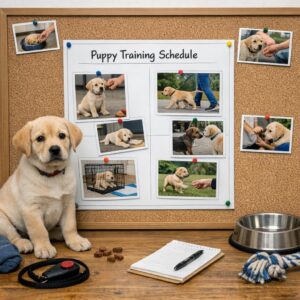
Use a Training Log to Improve the Human Side of the Lesson
Good Home Training Is a Communication System
The beginner’s goal does not need to be perfect obedience.
A useful training system helps the dog understand which behaviors work in specific situations and helps the human recognize when an exercise has become too difficult.
Define the behavior clearly. Create an environment where the dog can succeed. Teach the action before naming it. Reinforce useful choices. Expand the behavior across contexts gradually. And use management when real life becomes more difficult than the dog’s current training level.
Train the situation you want, not an abstract idea of an “obedient dog.”
Choose one observable behavior, make the first version easy, teach it with reward-based methods, add a clear cue when the dog understands the action and gradually move the skill into real life. When the response breaks down, adjust the lesson rather than assuming defiance. And when fear, aggression, pain or a sudden behavioral change is involved, move beyond generic home training and seek appropriate professional guidance.
Training and veterinary behavior references
The framework in this article is intended for ordinary home training. Significant behavioral or medical concerns require individualized professional assessment.
- American Veterinary Society of Animal Behavior — Humane Dog Training Position Statement
- VCA Animal Hospitals — Training Basics, Markers, Shaping and Cues
- VCA Animal Hospitals — Adding Cues and Generalizing Behavior
- VCA Animal Hospitals — Predictable Rewards and Everyday Training
- VCA Animal Hospitals — Veterinary Behavior Consultations
- Dogs Trust — Positive Reinforcement Training
- Dogs Trust — Practical Training Guidance
- RSPCA — Reward-Based Dog Training
- RSPCA — Choosing a Reward-Based Dog Trainer
The Dogs Dance Editorial Team publishes practical guides about humane dog training, mental stimulation, enrichment activities, canine tricks, and responsible routines at home. Our content is created for general educational purposes and focuses on clear explanations, realistic expectations, and the everyday well-being of dogs and their families. It does not replace veterinary diagnosis, treatment, or individualized guidance from a qualified animal behavior professional.