Trick Skill Portfolio
Choose tricks by what they teach
A trick can be more useful than its final performance suggests.
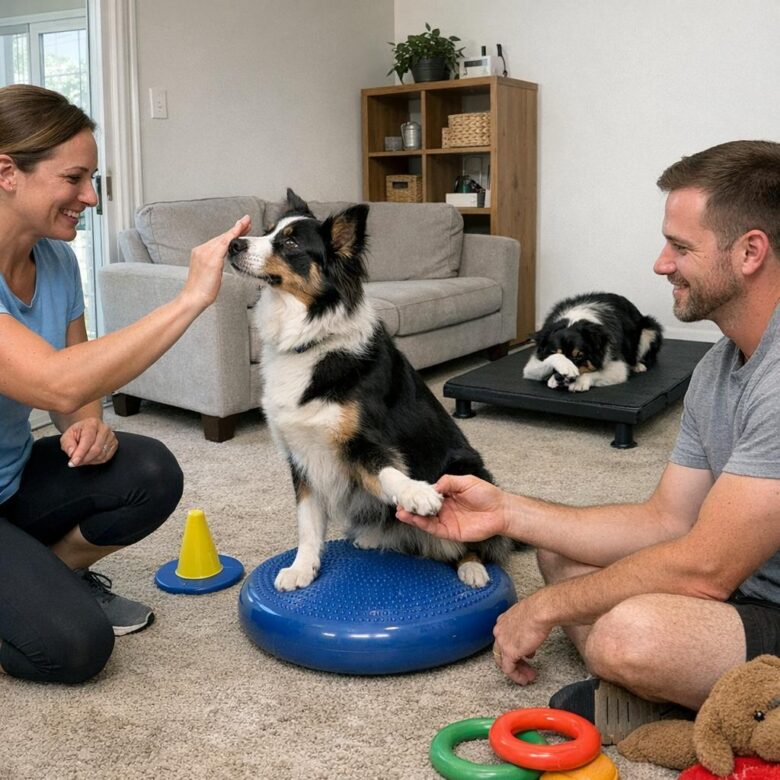
Resting a chin on a hand can introduce voluntary handling. Walking through a tunnel can teach a dog to investigate an unfamiliar setup at its own pace. Putting toys into a basket combines several learned behaviors into a sequence.
Instead of ranking tricks by how impressive they look, choose projects that practice a skill your dog can use elsewhere.
Do not use tricks as personality promises.
Trick training can provide enrichment, predictable communication and successful learning experiences. It should not be advertised as a guaranteed cure for fear, anxiety, lack of confidence or a weak human-animal relationship.
What Can Trick Training Realistically Support?
Engagement
Practice paying attention to a task
Targeting, object work and cue discrimination give the dog a clear problem to work on with the handler.
Predictability
Make successful choices understandable
Clear cues and consistent reinforcement help the dog learn which actions produce valued outcomes.
Cooperation
Build voluntary participation
Some trained behaviors can later make handling, movement and routine care easier without physically forcing the dog into position.
VCA veterinary behavior guidance notes that predictable reward-based cues can reduce frustration and conflict, while allowing dogs to learn that their choices influence outcomes.
Confidence is situation-specific.
A dog that becomes comfortable putting its head through a large open tunnel has learned something about that particular task. That does not prove the dog will suddenly feel confident around thunderstorms, strangers or other unrelated challenges.
Build a Portfolio of Different Skills
Project 1: Teach a Voluntary Chin Rest
01
Chin Rest
The dog voluntarily places the chin on a hand or suitable support.
Cooperation
Why this project is useful
Unlike a purely decorative trick, a comfortable chin rest can become part of preparation for calm handling around the face and head.
Begin with brief comfortable contact beneath the chin.
Touch gently and immediately reinforce if the dog remains comfortable.
Present your hand as a predictable resting surface.
Keep it still rather than lifting the dog’s head into position.
Mark voluntary contact.
Reinforce the moment the dog chooses to place weight or rest the chin on your hand.
Build duration gradually.
Ask for only a slightly longer rest after the shorter version is easy.
Add a cue only after the position is predictable.
Use a word or visual signal that is distinct from other trained behaviors.
Skill transfer
The same voluntary position can later be incorporated into appropriately managed grooming or veterinary-care preparation.
Watch for
Pulling away, freezing, avoiding the hand or signs of pain. Do not hold the dog’s head in place.
This is not restraint disguised as a trick.
Dogs Trust uses gradual chin-touch and chin-rest exercises when preparing dogs for procedures around the eyes and ears. The value comes from teaching the dog to participate voluntarily rather than physically immobilizing the head.
Project 2: Walk Through a Tunnel
02
Tunnel Walk-Through
The dog voluntarily travels through an open, stable tunnel.
Exploration
Why this project is useful
The goal is not speed. It gives the dog an opportunity to investigate an unfamiliar opening and learn how reinforcement can make a new task predictable.
Start with a very short, wide opening.
A large open cardboard box can work if it is stable, supervised and comfortably large enough for the dog.
Allow investigation before asking the dog to enter.
Sniffing or looking at the setup can be reinforced if the dog appears uncertain.
Create an easy route through.
Use well-placed rewards initially so the dog does not need to force through a frightening or narrow space.
Reduce the visible lure.
Once the path is familiar, reward after completion rather than creating a permanent food trail.
Add a distinct cue if useful.
A visual or verbal signal can eventually predict the familiar tunnel behavior.
Skill transfer
Provides practice approaching a new but controlled environmental feature voluntarily.
Watch for
Backing away, freezing, attempting to escape or refusing food. Make the opening easier rather than pushing the dog through.
Do not turn this into forced exposure.
Dogs Trust recommends beginning with a wide, easy tunnel and progressing gradually if the dog is apprehensive. The dog should be able to approach and move through voluntarily.
Project 3: Teach the Dog to Put Toys Away
03
Tidy the Toys
Pick up a toy, move to a container and release it inside.
Behavior chain
Why this project is useful
This trick demonstrates how several simple behaviors can become one longer sequence without requiring each component to be taught simultaneously.
Skill A
Pick up
Dog learns to take an appropriate toy.
Skill B
Carry
Dog moves while maintaining a comfortable hold.
Skill C
Find basket
The container becomes a target location.
Skill D
Release
Dog drops the toy inside the container.
Train pickup before worrying about the basket.
Mark and reinforce progressively stronger interaction with a familiar toy until picking it up is reliable.
Teach a voluntary release separately.
Reinforce dropping the toy rather than pulling it out of the dog’s mouth.
Make the basket a destination.
Reinforce approaching or orienting toward the basket before expecting the complete sequence.
Bring pickup and basket together.
Begin with the toy very close to the container so only a small amount of carrying is needed.
Gradually increase distance.
Progress only after the shorter sequence works reliably.
Skill transfer
Teaches the handler how to construct a behavior chain from several independently trained components.
Watch for
Resource guarding, destroying or swallowing toy pieces, or frustration when too many steps are combined at once.
Dogs Trust currently teaches this trick in essentially the same modular way: first pickup, then a drop behavior, then targeting the basket, and finally combining those pieces into the full sequence.
Project 4: Teach a Nose-Controlled Ball Roll
04
Roll the Ball
The dog moves an appropriately sized ball using the nose.
Precision
Why this project is useful
It demonstrates shaping: the criterion changes from noticing an object to touching it and eventually producing a specific effect — movement.
Present a safe ball.
Choose one large enough that the dog cannot swallow it and appropriate for the dog’s chewing style.
Mark investigation.
At first, sniffing or touching the ball can earn reinforcement.
Place the ball on the floor.
Continue reinforcing nose contact without requiring a powerful push immediately.
Raise the criterion to movement.
Once touching is reliable, reinforce the contacts that make the ball roll.
Shape direction only later.
If you eventually want the ball moved toward a target, begin with a broad target area rather than requiring precision immediately.
Skill transfer
Helps the handler practice raising criteria gradually instead of demanding the final behavior from the first repetition.
Watch for
Ball chewing, attempts to swallow objects, frantic pawing or a slippery surface that makes movement unsafe.
NOSE
→ BALL
Reward the effect you are currently teaching.
Dogs Trust’s current dog-bowling exercise begins by rewarding interest and nose contact with a ball, then raises the criterion to nudges that actually move it.
This is a useful demonstration of shaping because “touch the ball” and “make the ball roll” are related but different criteria.
Project 5: Teach the Dog to Choose Between Two Targets
05
Target Choice
Two different visual targets predict two different responses.
Discrimination
Why this project is useful
The dog learns that visually different cues can carry different meanings rather than simply following the handler’s hand toward whichever object is closest.
Start with clearly different targets
●
Target A
DIFFERENT
▲
Target B
Teach Target A by itself.
Reinforce approaching or touching that target until the behavior is reliable.
Teach Target B separately.
Use a distinct cue and avoid presenting Target A during these early repetitions.
Present both targets with generous separation.
Give one familiar cue and reinforce choosing the corresponding target.
Switch the requested cue across repetitions.
Keep the setup simple enough that mistakes do not dominate the session.
Move the targets to prevent location from becoming the real cue.
If Target A is always on the left, the dog may learn “go left” instead of distinguishing the visual target.
Skill transfer
Gives the dog practice responding to distinct cues and gives the handler practice separating visual information from location or body-language prompts.
Watch for
Repeated guessing. If success drops sharply, return to training each target separately.
This is cue discrimination — not evidence that the dog can read.
Dogs can learn associations with different visual stimuli. Avoid turning a trained response to symbols, cards or printed words into a claim of human-like literacy.
Choose a Trick According to the Skill You Want to Practice
| If you want to practice… |
Try… |
What the handler learns |
What not to claim |
| Voluntary positioning |
Chin rest |
How to reinforce cooperation without holding the dog in place |
That it will eliminate veterinary fear |
| Approaching a novel setup |
Tunnel |
How to reduce difficulty and let the dog investigate |
That one trick creates global confidence |
| Behavior chaining |
Tidy toys |
How to train several components before combining them |
That every dog will enjoy carrying objects |
| Precision shaping |
Ball roll |
How to raise criteria from contact to movement |
That harder or faster performance is always better |
| Cue discrimination |
Two-target choice |
How to make visual cues distinct and test what the dog actually learned |
That choosing printed symbols means the dog can read language |
Let the Dog’s Preference Influence the Portfolio
The most educational trick on paper is not useful if the dog consistently dislikes doing it.
One dog may love manipulating toys but hesitate around tunnels. Another may enjoy targeting and have no interest in picking up objects.
VCA emphasizes that the animal determines what functions as a reward. The same principle applies to activity choice: observe whether the dog voluntarily engages, remains comfortable and returns willingly to the game.
Do not interpret walking away as a character flaw. It may mean the reward is weak, the criterion is unclear, the setup is difficult, the dog needs a break or the activity simply is not appealing.
How Trick Training Can Support the Human-Dog Relationship Without Exaggerating the Claim
Useful interaction is built through predictability and cooperation
Dogs Trust and AAHA both describe trick training as an enrichment activity that can contribute positively to interaction between dogs and their people.
VCA notes that predictable cues and rewards can reduce conflict and help dogs understand how their choices produce outcomes.
That is a stronger editorial claim than saying a particular trick automatically “improves bonding.” Relationships are influenced by far more than a training exercise.
The AVSAB’s current position is also relevant: it warns that aversive methods present welfare risks and risks to the human-animal bond, while recommending reward-based training for all dog training and behavior modification.
Know When a Trick Should Be Changed or Abandoned
Change the lesson when:
- the dog repeatedly cannot find the correct answer;
- frustration increases with each repetition;
- the dog stops engaging with normally valued rewards;
- the environment is more distracting than the current skill can handle;
- the dog repeatedly walks away from the activity.
Stop and consider health when:
- movement suddenly becomes difficult;
- the dog limps or loses balance;
- touch causes an unexpected pain response;
- exercise tolerance changes significantly;
- a previously comfortable behavior becomes physically difficult.
A higher-value treat should not be used to persuade a dog through suspected pain.
Keep All Five Projects Reward-Based
Tricks do not justify aversive tools simply because the behavior is optional.
The American Veterinary Society of Animal Behavior reaffirmed in 2025 that reward-based methods should be used for all dog training and behavior modification.
There is no need to drag a dog through a tunnel, push the chin into a hand, physically force an object release, use leash corrections for incorrect choices or punish a dog that stops participating.
Finish the Training Project at the Dog’s Useful Level
Level A
Understands it
The dog can perform the basic behavior comfortably in the training setup.
Level B
Enjoys repeating it
The dog voluntarily participates and the behavior remains rewarding to practice.
Level C
Transfers somewhere useful
The skill contributes to handling, enrichment, communication or another appropriate real-life activity.
You do not need a fourth level called “make it more difficult.”
If the trick already works for the purpose you wanted, keeping the easy version is a valid training decision.
A Good Trick Portfolio Teaches More Than Performance
The strongest collection of tricks is not necessarily the collection with the most dramatic movements.
A chin rest can teach voluntary cooperation. A tunnel can teach the handler how to make unfamiliar tasks approachable. Tidying toys demonstrates chaining. Ball rolling demonstrates shaping. Target discrimination teaches the importance of clear cues and controlling unintended signals.
Those lessons remain useful even if the dog never performs any of the tricks for an audience.
Choose tricks for the learning experience they create, not for a promise about what kind of dog they will produce.
Use reward-based training, make the first version achievable, watch whether the dog participates willingly and let each project practice a different skill. Trick training can provide valuable enrichment and cooperative interaction, but confidence, focus and relationships should not be reduced to a score based on how many behaviors a dog can perform. The most useful trick is one that is safe, understandable and worth doing for both members of the training team.
Training, veterinary behavior, and enrichment references
These projects are general enrichment and training ideas. Pain, significant fear, aggression, handling sensitivity or other behavioral and medical concerns may require individualized veterinary or qualified professional guidance.