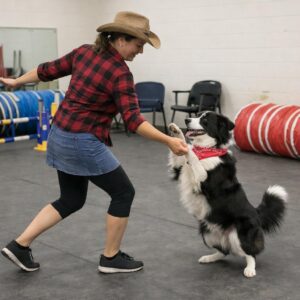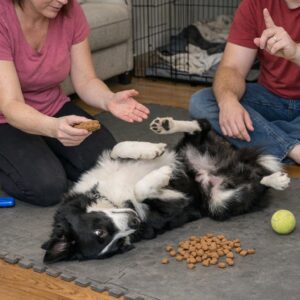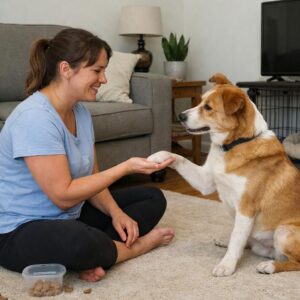
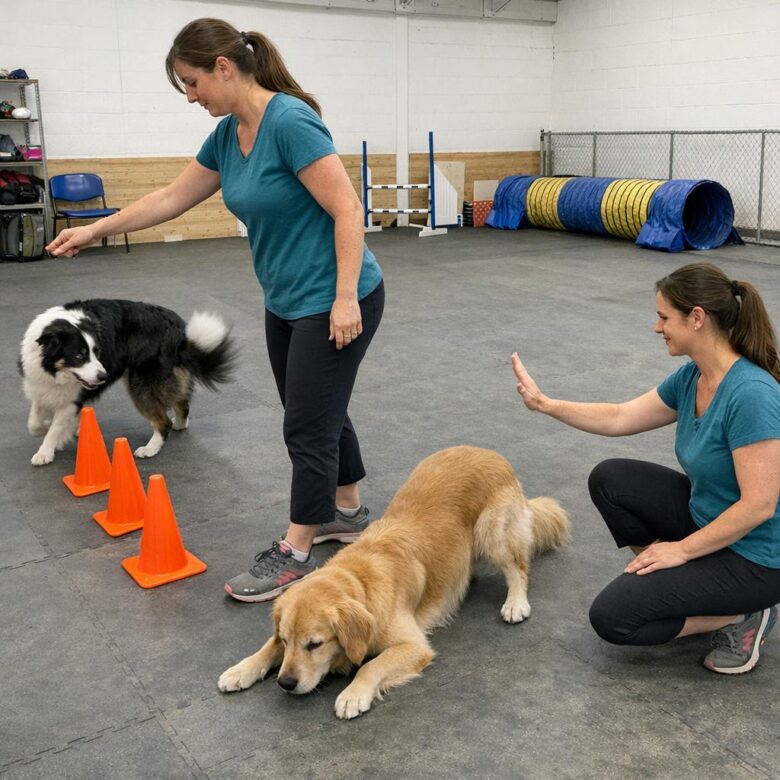
Spin, leg weaves and bow may look like three unrelated tricks, but they can be taught with the same underlying system.
First help the dog discover a comfortable movement. Then reinforce it until the path becomes predictable. Next remove the visible food from the guiding hand. Finally, turn the remaining movement of your hand or body into a clear visual cue.
That sequence matters because a hand signal should tell a dog which familiar behavior to perform — it should not have to physically guide the dog through the entire trick forever.
The Four-Part Blueprint
This progression is visible in current Dogs Trust trick guidance for figure-eight movement and in reward-based training resources from VCA: establish the behavior, fade the lure and then use a clear trained cue.
Check Physical Comfort Before Teaching Movement Tricks
- a nonslip surface;
- enough room for wide, controlled movement;
- a dog moving normally without obvious pain;
- small rewards appropriate for the dog’s diet;
- a quiet environment for the first repetitions.
- limps or repeatedly loses balance;
- hesitates during a movement that was previously comfortable;
- appears painful when turning or lowering the front end;
- cannot move safely on the available floor;
- has a veterinary restriction that conflicts with the movement.
Movement 1: Teach a Controlled Spin
TURN
TURN
Current AKC training guidance uses this same basic progression: lure a large circle, reinforce completion, remove food from the guiding hand and eventually use the circular hand motion as the cue.
Movement 2: Teach a Stationary Leg Weave
AKC guidance for a stationary leg weave follows this progression: teach one side, teach the other, connect both into a figure eight, remove the visible treat lure and eventually reduce the hand movement.
Dogs Trust uses the same fading principle in its figure-eight exercise around objects: once the dog follows the route comfortably, the food or toy is removed from the guiding hand and the hand motion is made progressively smaller.
Movement 3: Teach a Bow Without Pushing the Dog Into Position
AKC’s current bow-training instructions similarly begin from standing, use a food lure directed downward and back, reinforce the bow before it becomes a full down, then replace the food lure with an empty-hand gesture.
Movement 4: Turn Big Guiding Motions Into Hand Signals
A hand signal does not need to come from an official vocabulary. VCA’s veterinary behavior guidance notes that there is no single required set of visual signals. What matters is that each signal is clear, distinct and used consistently.
Give Each Movement Its Own Visual Identity
These are examples, not mandatory signals. The important design principle is contrast. Two gestures that look almost identical from the dog’s perspective are unnecessarily difficult to distinguish.
Consistency Matters More Than Choosing the “Perfect” Signal
VCA specifically advises that visual cues be discrete and consistent and notes that a dog may fail to recognize what humans consider “the same” signal when different people present it at different speeds or with different hand positions.
Practice Visual Signals Without Accidentally Giving Extra Clues
Dogs can notice much more than the movement you intended to teach.
A dog may actually be responding to your shoulders turning, your feet shifting, the treat pouch opening or your entire body leaning rather than the hand signal you believe is controlling the trick.
Once a trick is reliable, occasionally review what your body is doing:
- Can you give the signal without stepping toward the dog?
- Does the dog still respond if the reward stays hidden?
- Can another trained caregiver reproduce the same signal?
- Is the cue visible from the position where the dog normally performs the behavior?
You do not need to eliminate every piece of body language. The goal is simply to know what the actual cue is.
Combine the Tricks Only After Each One Works Separately
Troubleshoot by Looking at the Movement
| What happens | Possible reason | Useful adjustment |
|---|---|---|
| Spin stops halfway | The lure moved too far ahead or the circle became too tight. | Use a slower, wider arc and reinforce a successful version. |
| Dog always spins one direction | Only one direction has been trained clearly. | Teach the second direction as a separate behavior. |
| Dog hesitates between legs | The opening may feel too narrow or unfamiliar. | Widen the stance or use an around-object figure eight instead. |
| Bow becomes a down | The reward is arriving after the dog lowers too far. | Mark an earlier approximation before the elbows-and-body progression continues. |
| Trick works only with visible food | The lure has not been faded. | Repeat the familiar gesture with an empty hand and reward afterward. |
| Dog confuses two hand signals | The gestures may be too similar. | Increase visual contrast and retrain them separately. |
| Performance gets slower each round | Fatigue, frustration or physical discomfort may be increasing. | End the session and reassess instead of adding more repetitions. |
Keep Physical Safety Separate From Training Motivation
Modify the Tricks for Senior Dogs
VCA recommends accounting for age-related physical and sensory changes when training senior dogs. Some positions may be uncomfortable for arthritic or mobility-limited dogs, while visual cues may become particularly useful when hearing declines.
A senior dog does not need deep bows, tight spins or moving leg weaves to participate in training. A hand target, simple directional movement or another low-demand trick may be a better choice.
Use a Movement Record Instead of Counting Tricks
Reward-Based Training Applies to Tricks Too
The American Veterinary Society of Animal Behavior continues to recommend reward-based methods for all dog training.
There is no need to physically push a dog into a bow, drag a dog through a leg weave, jerk a leash to create a turn or punish an incorrect response.
If a movement does not happen, change the setup. Make the path clearer, lower the criterion, improve the reward, create more physical space or choose another behavior.
The Final Hand Signal Should Be the Smallest Useful Version of the Original Lesson
The interesting part of these tricks is not simply that a dog can spin, weave or bow.
It is that the handler can start with a large, obvious training movement and gradually transform it into a precise piece of communication.
A full circular lure becomes a small circular signal. Large alternating guidance through the legs becomes a compact weaving cue. A food lure lowering toward the floor becomes a distinct downward gesture.
At that point, the dog is no longer simply following food. The visual movement has acquired meaning.
Build the path first, then build the cue.
Teach spin as a controlled circle, divide leg weaving into manageable loops, shape a comfortable bow without physically positioning the dog, and gradually remove food from the guiding hand. Keep each final hand signal distinct and consistent, practice individual movements before chaining them together, and adapt or replace any trick that appears physically uncomfortable. Good visual communication comes from making a familiar behavior easier to recognize — not from making the handler’s gestures bigger and louder forever.
Training and veterinary references
The movements in this article are general trick-training examples for dogs without conflicting physical restrictions. Pain, mobility changes or unexplained difficulty with movement should be discussed with a veterinarian.
- American Veterinary Society of Animal Behavior — Humane Dog Training Position Statement
- VCA Animal Hospitals — Teaching Visual and Hand Signals
- VCA Animal Hospitals — Trained Cues and Predictable Rewards
- Dogs Trust — Teaching a Figure of Eight and Fading the Lure
- Dogs Trust — Target Training and Clear Reward-Based Guidance
- American Kennel Club — Teaching a Spin
- American Kennel Club — Teaching a Stationary and Moving Leg Weave
- American Kennel Club — Teaching a Bow
- American Animal Hospital Association — Indoor Activity Safety
The Dogs Dance Editorial Team publishes practical guides about humane dog training, mental stimulation, enrichment activities, canine tricks, and responsible routines at home. Our content is created for general educational purposes and focuses on clear explanations, realistic expectations, and the everyday well-being of dogs and their families. It does not replace veterinary diagnosis, treatment, or individualized guidance from a qualified animal behavior professional.